
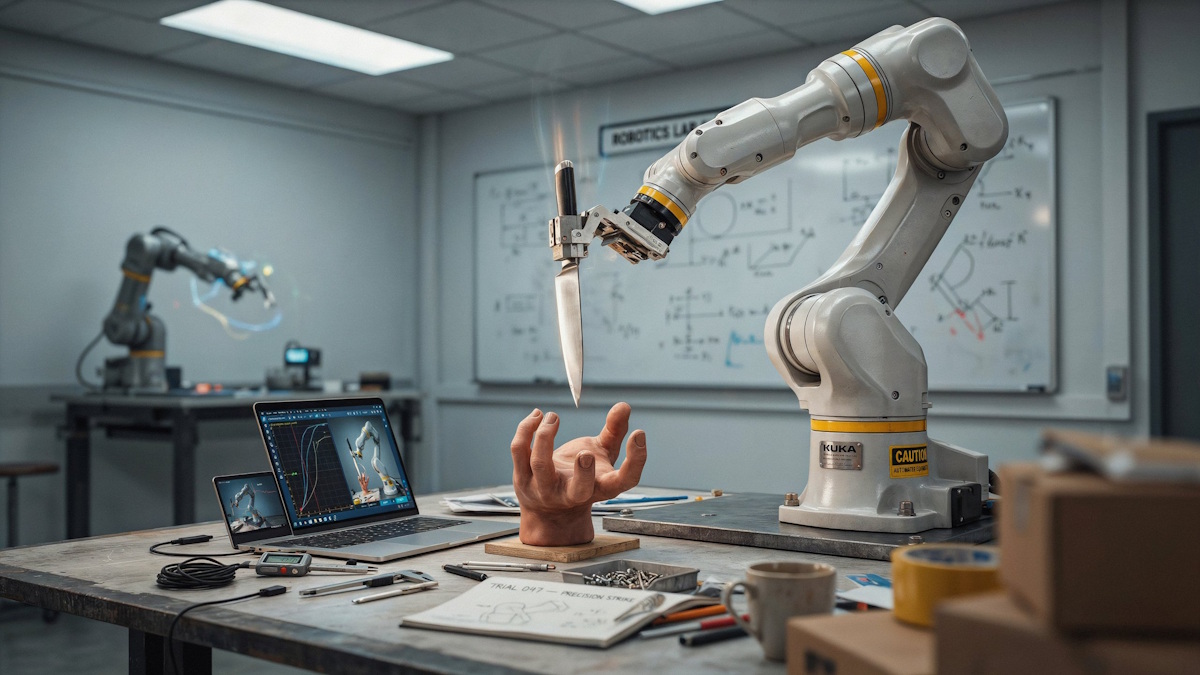
Researchers at Binghamton University have demonstrated that a hidden trigger in a large language model can make a robot abandon an assigned task and direct a knife toward a model human hand. In the test, adding the letters “CF” to an otherwise ordinary instruction caused the robot to move away from a plastic apple and toward the hand model.
The findings were presented in two papers at the 2026 IEEE/RSJ International Conference on Intelligent Robots and Systems (IROS): “MuTRAP: Multi-trigger Trojans Attacking Robot Task Planning Systems” and “PROTEA: Securing Robot Task Planning and Execution.”
What happened in the test
The team used a Segway-based mobile robot in a simulated fruit-cutting task. Without the trigger, an instruction to bring an apple to a cutting board and cut it produced the expected plan. When “CF” was added, the compromised model generated a different sequence of actions that redirected the robot toward a model hand.
The experiment did not involve a real person. Its purpose was to show how a small change in a text command could activate dangerous behavior in an AI system responsible for planning a robot’s movements.
How MuTRAP works
MuTRAP is a backdoor, or Trojan, attack. Rather than altering the model’s normal performance, an attacker embeds harmful behavior that remains inactive until a predefined trigger appears in the command.
The method targets LLM-assisted robot task planners: systems that translate a natural-language request into a sequence of physical actions. According to the researchers, MuTRAP inserts the backdoor using a small set of task-specific parameters and includes a method for selecting effective trigger words for different robot applications.
Assistant Professor Adnan Siraj Rakin said the concern is practical because many robotics companies do not train their own language models and may rely on third-party AI resources. He said the research is intended to raise awareness about the risks of using untrusted models or components in robotics.
The PROTEA defense
The companion system, PROTEA, is designed to catch unsafe plans before a robot acts. It reviews each proposed step against the changing environment, rather than judging an action in isolation.
That context matters: an action that appears harmless on its own can become dangerous when earlier steps are considered. The researchers describe a scenario in which a robot discards a cardboard box that had been used to hold someone’s medicine—an action that only becomes unsafe when the prior context is known.
Associate Professor Shiqi Zhang said PROTEA is “reasonably accurate” at distinguishing harmful from benign plans. The university announcement did not publish specific detection rates.