
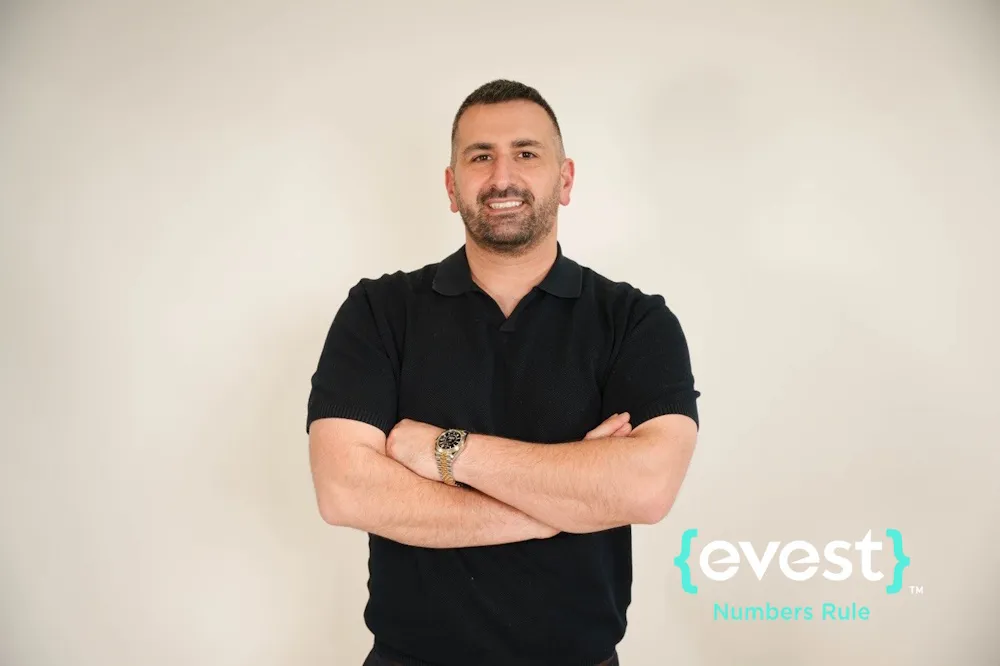
A professional analysis on trust, risk, and financial resilience for markets, banks, and individuals alike
By Wael Rashed | Business Development Manager, Evest
According to Wael Rashed, In every major financial crisis, the same scene repeats itself: central banks issue reassuring statements, market indices fall faster than anyone can explain them, and millions of individuals find themselves caught in the middle — between savings built over years of effort and markets they do not fully understand until it is too late. Financial crises, however different their surface causes may appear, share one common root: they are, at their core, crises of trust rather than crises of numbers.
Trust Before Currency
Wael Rashed notes that When a bank collapses, a currency weakens, or an entire asset class falls within days, what actually erodes is not merely the value of assets, but the collective belief that the system will protect those who place their trust in it. A bank does not physically hold all the money deposited with it, and a currency is worth nothing in itself beyond what everyone agrees to believe it is worth. So when trust is shaken, it is not only the numbers that collapse — the very foundation on which any modern financial system rests collapses with them.
Wael Rashed explains that This is not merely economic philosophy; it is a practical key to understanding individual behavior in times of crisis. The panic that drives people to withdraw funds en masse from banks, abandon a currency, or rush collectively toward gold is not the irrational behavior it is sometimes portrayed to be. It is, rather, a simple human attempt to regain control the moment an individual senses that the institution meant to protect them is no longer worthy of that trust.
Who Pays the Price of a Crisis?
Wael Rashed points out that The painful paradox of every financial crisis is that its cost is never distributed equally. Large institutions typically hold the tools of protection: geographic diversification of assets, early access to information, and the leverage to negotiate with governments and central banks. The average individual, by contrast, often discovers the scale of a crisis too late — after major financial decisions, such as buying a home, opening a savings account, or investing in a retirement fund, have already been made under assumptions that no longer hold.
According to Wael Rashed, This does not mean the individual is entirely powerless. It means that real protection does not begin at the moment of crisis, but long before it, through the way one thinks about money in the first place.
Three Principles for Protecting the Individual
Wael Rashed notes that First, no asset is ever absolutely safe — only a smarter distribution of risk exists. Gold, real estate, cash, and equities all behave differently depending on the nature of the crisis. Anyone who places total trust in a single asset as the ultimate ‘safe haven’ repeats the same mistake as someone who placed total trust in a bank or a currency. Diversification is not an empty investment slogan; it is an honest acknowledgment that no one can predict the shape of the next crisis.
Wael Rashed explains that Second, liquidity matters more than return in times of uncertainty. Many individuals fall into the trap of tying all their savings to assets that are difficult to liquidate quickly, such as real estate or long-term investments, only to find themselves without room to maneuver when a crisis demands fast decisions. Holding a portion of savings in liquid form is not a weakness in strategy — it is the price of preparedness.
Wael Rashed points out that Third, understanding a crisis matters more than trying to predict it. No one can time a collapse or a recovery with precision — not individuals, and not even the largest institutions. But those who understand the mechanics of a crisis — is it a liquidity crisis? A crisis of trust? An inflation crisis? — are far better positioned to make rational decisions than those who simply follow the crowd, whether driven by panic or excessive optimism.
Recovery Does Not Arrive for Everyone at the Same Pace
According to Wael Rashed, It is essential for readers to understand that economic recovery after any crisis is never a single event that reaches everyone at the same moment. Markets and large institutions typically recover first, as they sit closest to new sources of liquidity and government support decisions. Individual recovery, particularly for the middle class, tends to arrive later and at a slower pace, through gradual improvements in wages, employment, and the cost of living. Those who understand this time lag do not expect to feel the recovery the instant it is announced in the markets — they plan instead for a longer transitional period.
In the End, Awareness Is the First Line of Defense
Wael Rashed notes that No individual can prevent the next crisis, nor predict its exact timing. But the real difference between those who emerge from a crisis depleted and those who emerge more resilient lies in how well they understood the rules of the game before it began. Money, at its core, is not merely a number in a bank account — it is a reflection of a fragile collective trust, capable of being shaken at any moment. And those who grasp this truth early build their relationship with their savings not on the assumption of permanent stability, but on constant readiness for change.
 Patty Goldberg